April 18, 2026: A New Study Proposed By MIT Researchers Reveals The Potential Characteristics Of Waves On Worlds Like Titan Or Kepler 1649-b
A new study entitled "Modeling Wind-Driven Waves on Other Planets: Applications to Mars, Titan, and Exoplanets", proposed by a team of researchers involving Una G. Schneck and Andrew D. Ashton and published on April 3, 2026 in the Journal of Geophysical Research: Planets reveals the potential characteristics of waves on different worlds depending on key factors like gravity, atmospheric pressure, air density or the composition of the liquid. In the Solar System, there are not numerous worlds that contain stable lakes, seas or oceans on their surface. We live in an ocean world where about 71 percent of the surface is covered with liquid water. Beyond the Earth, there is also a particular world where stable pools of liquids can be found. That world is Titan, the largest moon of the Gas Giant Saturn. Planetologists are particularly interested in the potential composition and in the potential dynamics of the lakes, seas or rivers of Saturn's largest moon. The new study is based on a wave model that was applied to Mars, Titan, Kepler 1649-b, LHS 1140-b and 55 Cancri-e. The physical and chemical conditions can be radically different from one world to another world making the analytical work particularly complex.
The team of Una G. Schneck adapted a physics-based numerical wave model to study the influence of the environmental conditions on the physical characteristics of the waves. The behavior of the waves will be different depending on the level of gravity, depending on the atmospheric pressure, depending on the air density, depending on the density of the liquid or depending on the strength of the wind. The researchers envisaged lakes of water on the ancient Mars, lakes of hydrocarbons and nitrogen on Titan today and in the past, pools of sulfuric acid on the exo-Venus Kepler 1649-b, liquid water on the super-Earth LHS 1140-b as well as liquid rock on the super-Earth 55 Cancri-e. Their simulations were applied to those types of environments where ambient temperatures or gravity can be very different. It turns out that the waves will tend to be bigger for the liquids that have a weaker surface tension and that undergo a higher atmospheric pressure and a lower gravity. The waves tend to grow taller if they are less dense and if they undergo a higher atmospheric pressure and a lower gravity. Each world will have its own physical or environmental conditions and the dynamics of any lake, sea or ocean on that world will tend to be strongly influenced by those fundamental conditions.
The ancient Mars may have had the right environmental conditions for the presence of stable pools, seas or oceans of liquid water thanks to a heavier atmosphere. We know that the environmental temperature on the Red Planet can be relatively high from time to time in the equatorial region but the mean atmospheric pressure is extremely low so that water can only appear in its solid state on the surface even if the environmental temperature exceeds 0 degrees Celsius. In the past, the environmental temperatures of Mars may have been very different with a heavier atmosphere so that water may have been present in its liquid state on the surface. There may have been lakes, seas or oceans of liquid water on Mars a long time ago. Mars is much smaller than the Earth so that its mean gravity is significantly lower than the mean gravity of the Earth. The simulations of the team of planetologists suggest higher waves than on Earth on the ancient Mars due to the lower gravity and due to the fact that the same wind speed can engender higher waves on Mars than on Earth. If the atmospheric pressure at the level of the surface is lower, the wave height will tend to be lower. Winds may have to be stronger to engender higher waves.
On Titan, the gravity is lower than on Earth or Mars because Titan is smaller than Mars and because its mean density is also lower than the mean density of Mars. The atmospheric pressure on the surface of Saturn's largest moon is much higher than the atmospheric pressure on the surface of Mars. The atmospheric pressure on the surface of that exotic moon is in fact higher than the atmospheric pressure on the surface of the Earth and the density of the air at sea level on Titan is also significantly higher than on Earth at sea level. That configuration of physical or environmental conditions is likely to allow the presence of relatively high waves on any lake, sea or ocean. Any stable lake, sea or river on Titan can't be composed of liquid water due to the extremely harsh environment in which ambient temperatures can be as low as -179 degrees Celsius, -290 degrees Fahrenheit or 94 Kelvin. Water can only appear in its solid form on the surface of the giant moon of the Ringed Planet. In the harsh environment of Titan, some hydrocarbons can appear in their liquid form on the surface. That's the case for methane (CH4), ethane (C2H6) and propane (C3H8).
Prior to the Cassini-Huygens mission in the Saturn System, some researchers had envisaged or imagined seas or oceans of methane or ethane composed of giant waves due to the particularly low gravity and due to the potential action of strong winds in an environment where the air is relatively dense. The mean density of liquid methane and liquid ethane is lower than the mean density of liquid water so that it is easier for winds to engender high waves. The exact composition of the lakes, seas or rivers is not known but they may be dominated by liquid methane or liquid ethane depending on the area or depending on the period of the year. Some lakes or seas may contain layers of different liquids. That's a particular configuration we don't have on Earth. The concentration of methane, the concentration of ethane and the concentration of dissolved nitrogen can vary depending on the lake or sea so that the dynamics of the pools can be different. The radar views of Titan acquired from the Cassini orbiter during the Cassini-Huygens mission in the Saturn System have clearly shown that there are lakes, seas and rivers on the surface of that world.
The lakes, seas and rivers of the Opaque Moon tend to be concentrated in the high latitudes or in the polar regions. That's quite surprising ! The radar views obtained with the Cassini orbiter have clearly revealed that the high latitudes of the northern hemisphere represented the most humid area of the exotic moon during the period of exploration of Saturn and its moons from 2004 to 2017. The first pool of stable liquids identified with the eyes of the Cassini orbiter had been found in the high latitudes of the southern hemisphere. That's Ontario Lacus, a pool whose shape looks like the shape of a foot. The southern hemisphere was experiencing the Summer season at the time of the first observations from the Cassini orbiter at the start of the Cassini-Huygens mission in the Saturn System. The analysis of the dynamics of Ontario Lacus suggests a remarkably smooth surface. Ontario Lacus may be almost as flat as a mirror. That's not what we could have expected in an environment where the gravity is so low and where the liquids are relatively light with a mean density that is lower than that of liquid water. Is Ontario Lacus a pond or a quiet environment where waves are absent or almost absent ?
The infrared or near-infrared views of the low or middle latitudes of Titan have clearly shown that the relatively dark areas that contrast with relatively bright areas are dominated by linear and parallel dunes extending over long distances. Those dunes demonstrate the potential strength of winds and the potential influence or action of prevailing winds on the landscape. Lakes or seas must be absent or almost absent in the low or middle latitudes. The surprising dynamics of a pool like Ontario Lacus may tell us something about the nature of the liquid or about the surface properties of the liquid. Can we imagine a thin layer of solid hydrocarbons above the lake or sea for instance ? Any layer of solid hydrocarbons would potentially prevent any strong wave from forming or developing. We have clearly observed dynamic cloud systems in the area of Ontario Lacus which implies that the air can be relatively active in the area. However, Ontario Lacus seems to be a quiet lake or sea ! At first sight, that's not in line with basic physics or with the simulations performed by the team of Una G. Schneck and Andrew D. Ashton. We will probably have to send a probe to Ontario Lacus in order to better understand the phenomenon.
The researchers also focused their attention on the exo-Venus Kepler 1649-b where pools of sulfuric acid could be encountered. In an environment where the mean gravity is roughly the same as the mean gravity of the Earth, the waves may not be as high as on Earth because the mean density of sulfuric acid is about twice as high as the mean density of water. Therefore, winds would have to be stronger than on Earth in order to engender high waves. The planetologists also studied the "cool super-Earth" LHS 1140-b, a world that is colder and larger than the Earth and that hosts liquid water. The specialists suggest that any wave on that world would be lower in a configuration where the wind speed is the same than on Earth due to a higher gravity. The researchers also considered 55 Cancri-e, another world that is completely different from the types of planets or moons we know in the Solar System. 55 Cancri-e is a lava world where the gravity is higher than on Earth and where surface liquids may be particularly viscous and denser than liquid water. One can imagine an ocean of liquefied rock in which waves must be particularly limited even if winds are relatively strong. The simulations of waves on other worlds can help us prepare new ambitious missions to the lakes or seas of Titan in particular.
|
|
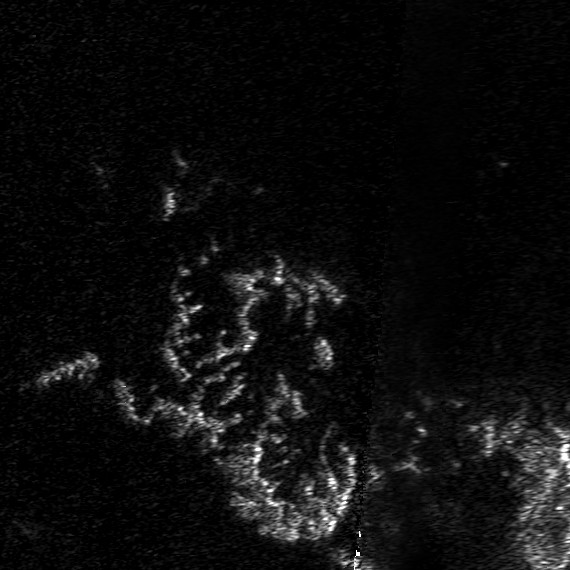
The image above represents a portion of a radar swath acquired from the Cassini orbiter during the T-92 Flyby of Saturn's largest moon performed on July 10, 2013. The file name of the original image is BIFQI39N235_D250_T092S01_V03.jpg. One can clearly see numerous islands in a pool of exotic liquids. The pool may be dominated by light hydrocarbons like methane and ethane. Are there strong waves or high waves in that lake or sea ? Credit for the original image: PDS Image Atlas. Montage credit: Marc Lafferre, 2026. |
- To get further information on that news, go to: https://news.mit.edu/2026/waves-hit-different-on-other-planets-0416 and https://agupubs.onlinelibrary.wiley.com/doi/full/10.1029/2025JE009490 .