February 14, 2026: Titan And Hyperion May Be The Outcome Of A Collision Between Two Moons
A new research work entitled « Origin of Hyperion and Saturn's Rings in A Two-Stage Saturnian System Instability », published in arXiv on February 9, 2026, accepted for publication in the Planetary Science Journal and proposed by a team led by Matija Cuk suggests that Titan and Hyperion could be the outcome of a collision between two moons. Titan is the largest moon of Saturn whereas Hyperion is a relatively small moon of the Ringed Planet that orbits farther away from the Gas Giant. The simulations show that a giant impact between the Proto-Titan and the Proto-Hyperion could have engendered the current configuration of the Saturn System in terms of orbital or physical characteristics. Hyperion is clearly a strange moon with strange craters, an irregular shape and an unstable inclination of its rotation axis. Titan is also a surprising moon with a deep and thick atmosphere and with a diversified landscape in which craters are relatively scarce. The researchers of the study imagine that the Proto-Titan could have resembled a cratered moon like Callisto. Hyperion could have taken shape on the basis of the debris related to the collision.
The new scenario put forward by the team of Matija Cuk, a scientist of the SETI Institute, can explain the unusual orbit of the Opaque Moon, the relatively limited amount of impact craters on Titan, the odd tilt of Iapetus, a major moon of Saturn evolving much farther from the Gas Giant than Titan as well as the surprising young age of Saturn's rings. The planetologists advance that a major moon may have collided with the Proto-Titan to engender the Orange Moon and the much smaller moon Hyperion. One can easily imagine a giant cloud of debris, dust, icy particles or gas engendering several moons or a new moon via aggregation and accretion processes. The simulations developed by the group of researchers lead to that potential configuration rather than a configuration in which the presumed ancient moon engendered the formation of the rings we know today. The presumed impact of the Proto-Titan and of the Proto-Hyperion may have engendered an alteration of the orbit of Titan destabilizing inner moons through orbital resonances. In that unstable environment, new collisions may have occurred and may have engendered the migration of scattered material inward leading to the famous rings of Saturn we all know.
Researchers believe that the rings of the Gas Giant may have taken shape approximately 100 million years ago. The inward migration of the scattered material related to the various impacts may have allowed the formation and the development of the rings. The Cassini-Huygens mission in the Saturn System has allowed us to capture a huge amount of data regarding the various moons of Saturn and regarding the surprising complexity of the bright rings of the Gas Giant. We have had the opportunity to evaluate the age of those rings and to determine the rapidly shifting orbit of the largest moon of Saturn. The rings may be relatively recent in terms of geological scale or cosmological scale. Those phenomena are in line with the hypothesis of a moon merger in which a major moon may have collided with the Proto-Titan. The Cassini spacecraft had been in a position to evaluate the internal mass distribution of Saturn near the end of its mission. That internal mass distribution has an influence on the slow spin-axis wobble or precession. Planetologists had long believed that the precession period of Saturn matched the precession period of Neptune allowing the gravitational interactions of both worlds to progressively tilt the rotation axis of Saturn unveiling its rings.
The final path of the Cassini probe revealed that the mass of Saturn is in fact slightly more concentrated at the level of its center than expected modifying its precession rate so that it is no longer in line with the precession rate of Neptune. In order to account for that configuration, the researchers at MIT and UC Berkeley envisaged the configuration in which an extra moon passed near Titan and was ejected toward Saturn breaking up close to the Gas Giant to form the rings we know today. They resorted to computer simulations in order to evaluate the evolution of the system of moons if the presumed ancient moon approached the Gas Giant so that rings could form. The conclusion of the planetologists is that a collision between the Proto-Titan and the ancient moon must have occurred. Today, one can observe that the small moon Hyperion whose shape is irregular and which is constantly tumbling is in a locked orbit with the Opaque Moon. The team of Matija Cuk has been in a position to determine that if the presumed ancient moon became unstable, Hyperion often disappeared or survived only in rare configurations.
The researchers believe that the current configuration of Titan and Hyperion is relatively young, cosmologically speaking. The lock may be only a few hundred million years old. The ancient moon may have disappeared roughly at the same time in that period. Hyperion could be the outcome of the collision via aggregation or accretion processes or could have been significantly influenced by the collision. A parallel could be drawn between the collision involving the hypothetical planet Theia and the Proto-Earth that led to the formation of the Moon and the presumed collision between Titan and the ancient moon that could have produced fragments near its orbit. The fragments may have engendered the formation of Hyperion near the orbit of Titan. The researchers of the study believe that the Proto-Titan may have been almost as large as Titan today. Obviously, the Proto-Hyperion may have been much smaller ! The mean diameter of Saturn's largest moon is currently about 5151 kilometers whereas the longest dimension of the irregular moon Hyperion is 355 kilometers. The Proto-Titan may have been devoid of any atmosphere probably resembling a moon like Callisto, a heavily cratered moon of Jupiter.
The current appearance of Titan may be completely different from the appearance of the Proto-Titan due to the dense and opaque atmosphere that tends to protect the surface from meteorites or comets. The infrared or near-infrared views as well as the radar images of Titan acquired from the Cassini orbiter during its long mission in the Saturn System from 2004 to 2017 have clearly shown that Titan is an active world with dunes fields, lakes, seas and rivers and with a limited concentration of craters. Cryovolcanic phenomena or geysers may also be present on the surface like on a moon like Enceladus or Triton. The collision may have brought a huge amount of energy to the largest moon, turning a dead world into an active world with active tectonic processes or cryovolcanism. The eccentric orbit of the Opaque Moon that is progressively becoming rounder or less eccentric implies a recent disturbance from the Proto-Hyperion. The planetologists were also in a position to determine that before its presumed collision, the Proto-Hyperion had tilted the orbit of the distant moon Iapetus, a moon whose semi-major axis around Saturn is 3 560 840 kilometers.
The presumed collision of the Proto-Titan and of the ancient moon is likely to explain many phenomena of the system of moons around Saturn including the remarkably inclined orbit of the major moon Iapetus. The origin of the famous rings of Saturn is a major topic of research and numerous hypotheses have been advanced to explain the current configuration of rings. Some researchers of the SETI Institute team had proposed over ten years ago that the rings represent debris resulting from collisions between medium-sized moons evolving closer to the Gas Giant. This hypothesis is in line with simulations performed by the University of Edinburgh and by NASA Ames Research Center. The simulations reveal that new moons form from the collision and that a fraction of the debris migrate inward to form rings. The Sun is likely to play a role in the inner-moon crash or collision. The new study suggests however that the inner-moon collision can be the outcome of the presumed collision between the Proto-Titan and the presumed ancient moon. The eccentric orbit of the giant moon of Saturn is likely to destabilize some inner moons depending on orbital factors.
The evolution of the eccentricity of the orbit of Titan can engender the phenomenon of orbital resonance, an orbital configuration in which the period of other moons of the Gas Giant represents a fraction of the orbit of Titan so that orbits can align implying strong variations in the gravitational influence of the moons. The expanding orbit of the Opaque Moon is likely to engender the phenomenon of orbital resonance. Smaller moons can be destabilized by the phenomena of orbital resonance because their orbit can be modified with more eccentric orbits increasing the risk of collisions with neighboring moons over geological time scales. The presumed collision between the Proto-Titan and the ancient moon or the Proto-Hyperion must have engendered that type of instability. And the rings of Saturn that are relatively recent may have been engendered by that instability implying a series of collisions. The rotorcraft of the Dragonfly mission, supposed to arrive at Titan in 2034, is likely to allow us to test the scenario of the team of Matija Cuk. The nuclear-powered octocopter will analyze the geology and the chemistry of the environment of the giant moon so that any sign of a previous major collision half a billion years ago could be identified.
|
|
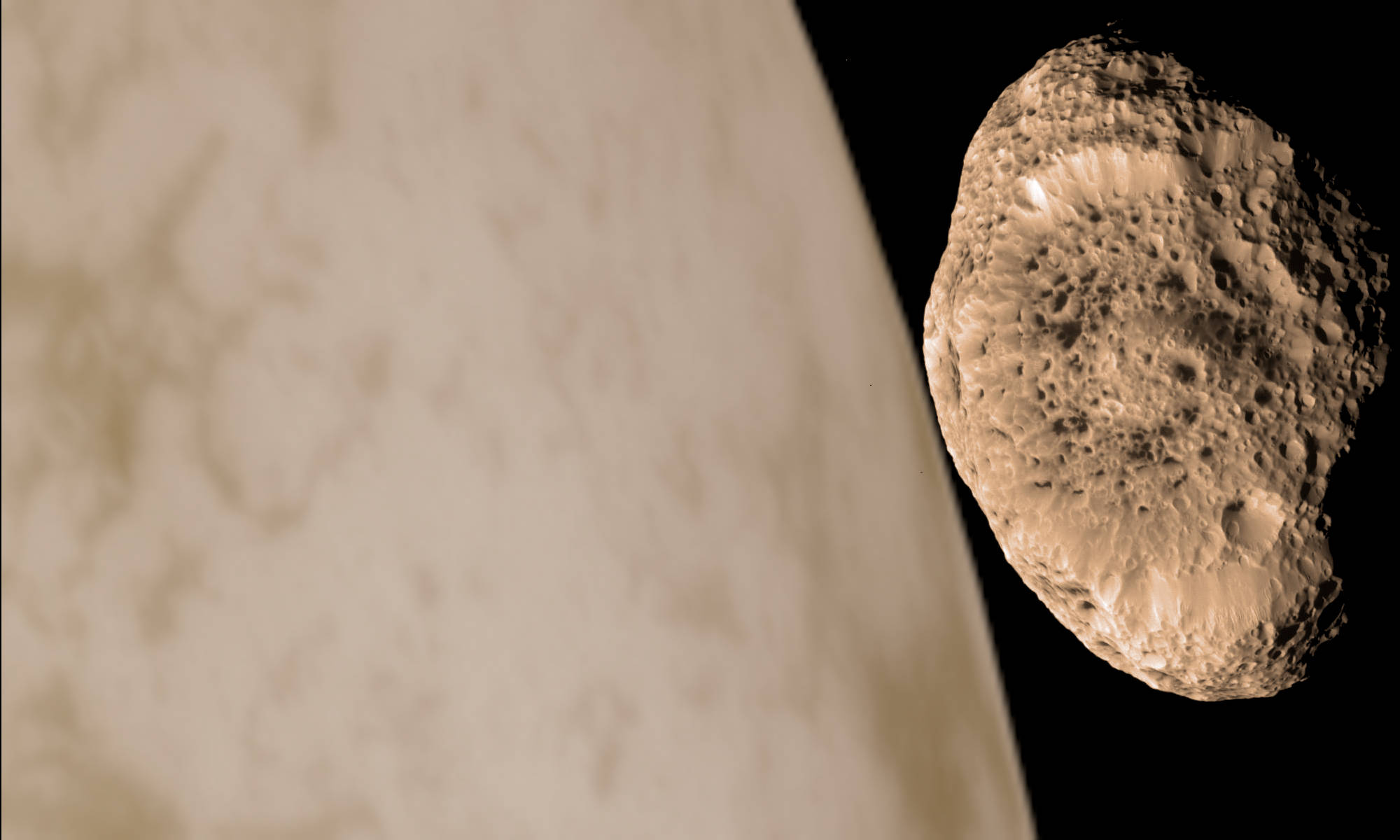
The image above reveals a portion of Titan as well as the little moon Hyperion at scale. The portion of Titan was generated on the basis of a global mosaic of its surface in the near-infrared at 938 nanometers. The file name of the global mosaic is PIA22770.jpg. The view of Hyperion was produced on the basis of data obtained on September 25, 2005 from the Cassini spacecraft. The file name of the original view of Hyperion is N00040238.jpg. Those moons of the Ringed Planet may result from a collision between the Proto-Titan and the Proto-Hyperion. Credit for the original view of Hyperion: NASA/JPL-Caltech/Space Science Institute. Credit for the global mosaic of Titan: NASA/JPL-Caltech/University of Arizona. Montage credit: Marc Lafferre, 2026. |
- To get further information on that news, go to: https://www.seti.org/news/saturns-moon-titan-could-have-formed-in-a-merger-of-two-old-moons/ and https://arxiv.org/abs/2602.09281.