March 20, 2026: Can The Earth Represent A Natural Laboratory To Understand A World Like Titan ?
A new study entitled « Terrestrial Analogs to Titan for Geophysical Research », proposed by a team of researchers involving Conor A. Nixon and several other planetologists and published in arXiv on February 19, 2026 reveals the geophysical and geological parallels between our own planet and Titan, the largest moon of Saturn. The study mobilized many specialists to explore and to study areas of the Earth in order to extrapolate what we could find on a world like Titan where common meteorological phenomena could be encountered. The Earth and Titan unveil varied landscapes from dune fields to mountains, irregular terrains, lakes, seas, rivers or tectonic phenomena. From outer space, Titan looks like Venus to a certain extent because its atmosphere appears completely opaque and roughly uniform in the visible spectrum from any spacecraft. However, the surface conditions on Titan are radically different from the surface conditions on Venus simply because the Opaque Moon evolves much farther from the Sun and because the greenhouse effects are much more limited on Titan. The environmental temperature on Titan is much lower than the lowest environmental temperature encountered on Earth, in the Antarctic for instance.
In an environment where the level of energy received from the Sun is particularly low, at a distance of around 1.4 billion kilometers from the Sun, the environmental temperature at the level of the surface is around -179 degrees Celsius, -290 degrees Fahrenheit or 94 Kelvin. That's a really harsh environment that contrasts with the environment of Venus where the surface temperature is so high that lead can be found in its liquid form on the surface for instance. In the environment of Titan, molecules like methane, ethane and propane can be found in their liquid form on the surface. In other words, they could form lakes, seas or rivers in the exotic environment of the largest moon of Saturn. And that's what we have been in a position to observe beneath the veil of the atmosphere of Titan thanks to the Cassini orbiter that has acquired a huge amount of data during its orbital dance of Saturn and its moons from 2004 to 2017. The Earth is not the only world of the Solar System where stable pools of liquid can be found ! Titan is also a sea world and the humid areas tend to be found in the high latitudes of each hemisphere. There is a meteorology dominated by water on Earth whereas there is a meteorology dominated by methane and ethane on Titan.
Planetologists and meteorologists can learn a lot by studying the atmosphere and the meteorology of Titan. The study of our own atmosphere and the study of our own meteorology can also help us anticipate what we could find in the atmosphere or on the surface of Titan even if the meteorology of Titan is based on another molecule than water. Liquid water can erode or shape the landscape on Earth and that's also the case for liquid methane or liquid ethane on Titan. Water (H2O) can't be present in its liquid form on the surface of the Opaque Moon due to the extremely low environmental temperature. Water can only be present in its solid form, in the form of water ice, on the surface of that world. The Huygens probe had acquired images of the surface of Titan where eroded stones or pebbles could be found. Those eroded stones or pebbles have probably undergone the action of a liquid. They are likely rich in water ice in an area where hydrocarbons and organics are relatively abundant. The rocks of Titan probably tend to be dominated by water ice whereas the rocks found on our own planet are relatively rich in silicon dioxide. In fact, the ingredients of the environment of Titan can be much different from the ingredients of our own environment.
Thanks to the Cassini-Huygens mission, we know, now, that there is a meteorological cycle involving methane and ethane on Titan where clouds of methane or ethane can take shape and develop, where rainfall events can occur as well and where rivers, streams, lakes or seas can be found like on Earth. The atmosphere of Saturn's largest moon looks like the atmosphere of the Earth to a certain extent because that exotic atmosphere is dominated by molecular nitrogen like the atmosphere of the Earth. The water vapor we have in our atmosphere in the form of clouds or humidity is replaced by methane in the atmosphere of Titan and methane can represent up to 5 percent of the composition of the air at sea level on that giant moon of Saturn. The atmosphere of that world contains a global haze rich in hydrocarbons and organics. Therefore, the environment of Titan clearly represents a natural laboratory to study the chemistry of organics in particular ! Titan may tell us a lot regarding the chemistry of organics in general, regarding the prebiotic chemistry or even regarding the chemistry of life. That's why we must go back to the surface of that moon !
The Orange Moon appears to have all the ingredients of life but in its extremely harsh environment where the level of energy received from the Sun is very low, the chemical reactions will tend to be particularly slow. At first sight, we may say that those types of harsh environment are not good for the development of any lifeform. Any lifeform based on liquid water could not be envisaged at the level of the surface of Titan simply because water appears completely frozen on the soil of that intriguing moon. However, we could envisage a lifeform based on liquid methane or liquid ethane at sea level on Titan because those liquids that can be present and stable in the high latitudes of that world can fuel chemical reactions and can represent solvents for the development of an exotic lifeform based on liquid methane or liquid ethane. Our biosphere is dominated by liquid water and carbon. As biologists or exobiologists say, we are CHNOPS. In other words, our chemistry is mainly based on carbon, hydrogen, nitrogen, oxygen, phosphorus and sulfur. All the organisms we know on Earth are dominated by water or liquid water. Without stable pools of liquid water on the surface of Titan, that biological configuration can't be envisaged !
In our exploration of the Solar System, we have already found key molecules of life on comets or asteroids. We have found sugars, amino acids or nucleobases on the asteroid Bennu for instance. More precisely, researchers have been in a position to identify several key molecules of life on that asteroid that is to say guanine, cytosine, adenine, uracil, ribose, phosphate as well as glucose. Guanine, cytosine, adenine and uracil represent the nucleobases of RNA, a key component of the life we know. This discovery demonstrates that the basic ingredients of life can take shape anywhere beyond the Earth. That's why the global haze of Titan must be an interesting environment to study the chemistry of hydrocarbons and organics. Ultraviolet light from the Sun can interact with molecules or particles of the upper atmosphere of Saturn's largest moon to engender new molecules that will fuel the haze. Heavier molecules will tend to fall to the surface. The radar views acquired from the Cassini spacecraft had clearly revealed that the relatively dark areas of the low or middle latitudes are dominated by linear and parallel dunes that look like the dunes one can find in the Namib Desert for instance.
Like on Earth, the dunes on Titan will tend to be sculpted by prevailing winds. The dunes of that world tend to extend over long distances. Their composition must be very different from the composition of the typical dunes one can find on Earth. They are probably rich in hydrocarbons or organics. The relatively low gravity and the relatively high density of the air on that moon must facilitate the development of those dunes. The contrast between relatively dark areas and relatively bright areas in the low or middle latitudes is surprising. The relatively bright areas may be richer in water ice whereas the relatively dark areas may be richer in hydrocarbons or organics. The relatively dark areas of the low or middle latitudes may represent ancient oceans or seas. If that is the case, the presence of a giant system of dunes could be explained. That is also the case for the Sahara desert on Earth which must have been wet or humid in the past. The infrared or near-infrared views obtained from the Cassini orbiter have clearly revealed that the low or middle latitudes tend to be relatively dry in normal times and that massive cloud systems can suddenly take shape and develop in the area likely engendering strong rainfall events.
The year on Titan is very long so that the analysis of its climate or meteorology is particularly complex. The year on Titan represents almost 30 Terrestrial years and each season on that world represents about 7 Terrestrial years. The Cassini-Huygens mission in the Saturn System has been very long but that's not enough to get the complete knowledge basis of Titan's meteorology and climate required to correctly analyze the climate and the meteorology of that exotic world. We have been in a position to determine that seasonal factors play a strong role on Titan. The level and the size of the lakes, seas or rivers may tend to be higher during the Winter period and lower in the Summer period. Planetologists must try to understand why the lakes, seas and rivers are mostly concentrated in the high latitudes of the giant moon. Is the dichotomy related to the presence of subsurface reservoirs of methane or ethane that fuel the pools for instance ? Is the dichotomy related to meteorological or seasonal factors ? Are there long term cycles related to the distribution of lakes or seas on that moon ? Some researchers believe that Titan may also contain a subsurface ocean rich in liquid water. Titan is clearly a fascinating world !
|
|
|
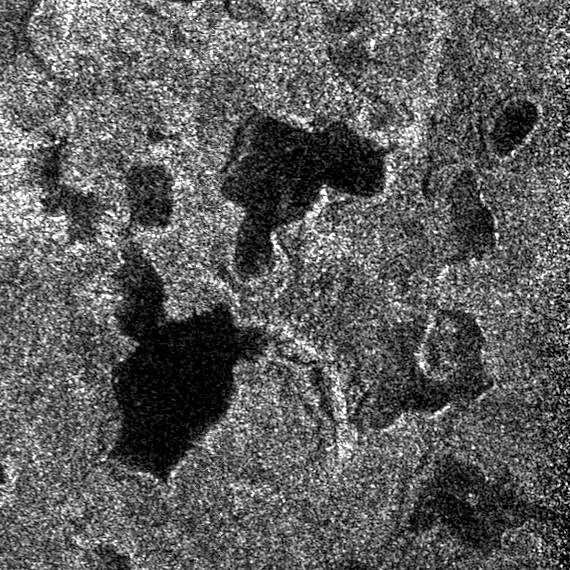
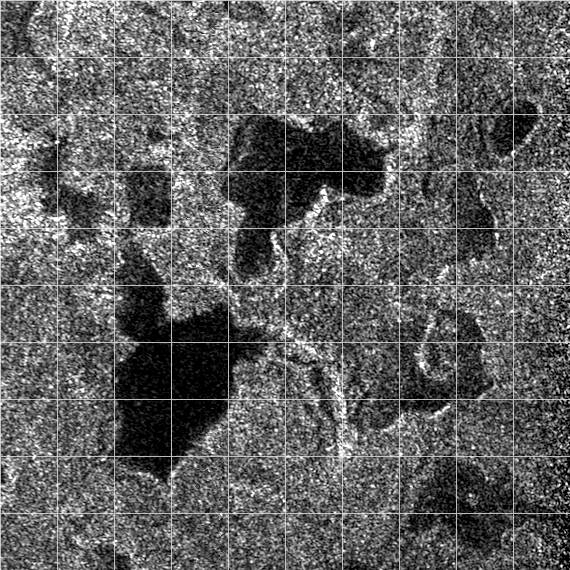
The image in the upper part of the table represents a portion of a radar swath of Titan obtained from the Cassini orbiter during the T-19 Flyby performed on October 9, 2006. The file name of the original view is BIFQI69N342_D100_T019S01_V03.jpg. Each side of the view represents about 100 kilometers. The image in the lower part of the table represents the same view with a grid for the scale. Each square of the grid is about 10 kilometers long. Several lakes can be clearly discerned in the image. Credit for the original view: PDS Image Atlas. Montage credit: Marc Lafferre, 2026. |
- To get further information on that news, go to: https://arxiv.org/abs/2602.17464.