October 17, 2025: A New Study Reveals Surprising Combinations Between Hydrogen Cyanide And Hydrocarbons In A Titan-Like Environment
A new study entitled « Hydrogen cyanide and hydrocarbons mix on Titan », published in the scientific journal PNAS on July 23, 2025 and proposed by a group of researchers involving Fernando Izquierdo-Ruiz, Morgan L. Cable, Robert Hodyss and Martin Rahm reveals the potential development of structures composed of hydrogen cyanide, methane and ethane in a harsh environment similar to the environment of Titan. That's surprising because molecules of hydrogen cyanide (HCN) represent polar molecules whereas molecules of methane and ethane represent nonpolar molecules. We tend to think that methane and ethane can't mix with hydrogen cyanide because hydrogen cyanide is a highly polar molecule. The new experiments and models demonstrate that, in the harsh environment of Saturn's largest moon, some key ingredients of the atmosphere or the soil that were thought to be incompatible in terms of combination can in fact mix to form interesting structures that can appear in their solid state. Hydrogen, carbon and nitrogen can combine to engender captivating molecules or substances that could lead to a prebiotic chemistry in the giant moon of the Gas Giant Saturn.
The new experiments open a new path or a new boulevard in our understanding of the chemistry of Titan's environment. The atmosphere of the giant moon represents a natural laboratory mobilizing hydrocarbons such as methane and ethane, molecular nitrogen and even more complex molecules taking shape in the global haze and in the upper atmosphere of that world where ultraviolet light from the Sun plays a key role via its interactions with the ions, the elements, the radicals or the molecules found in that region of the atmosphere. The Cassini orbiter and the Huygens probe have clearly revealed that the environment of Titan is rich in terms of landscape features, in terms of composition, in terms of chemistry or in terms of dynamics. Like on Earth, there are lakes, seas, rivers, dunes, mountains, fractures, clouds or cyclones on Titan. That world represents the perfect place to study the chemistry of organics and hydrocarbons. Thanks to the study of that intriguing world found more than 1 billion kilometers from us, we are in a position to better understand our world, the prebiotic chemistry and the chemistry of organics in general.
The team of Martin Rahm has clearly realized that the rule according to which polar and nonpolar compounds do not spontaneously mix is not always true in the Solar System. At cryogenic temperatures, the chemistry can be surprising and that's the case if we insert methane, ethane or small hydrocarbons into the crystal lattice of hydrogen cyanide. At first sight, hydrogen cyanide was not supposed to combine with methane or ethane because the molecule of HCN is highly polar whereas the hydrocarbons of methane (CH4) and ethane (C2H6) represent nonpolar molecules. Methane and ethane can be found in their liquid form on the surface of Titan where the environmental temperature evolves around -179 degrees Celsius, -290 degrees Fahrenheit or 94 Kelvin. HCN will tend to appear in its solid form on the surface of Titan. The researchers observe distinct shifts in vibrational modes by mobilizing Raman spectroscopy in the combination process of those ingredients. The predictions of the team based on computations confirm that cocrystal structures of hydrogen cyanide and ethane, which are in line with the experimental vibrational shifts, are thermodynamically and kinetically stable.
The Huygens probe had revealed, during its atmospheric descent, on January 14, 2005, bright areas, hills, dark channels as well as a brown plain that could represent an ancient sea. The bright areas may be rich in water ice or carbon dioxide ice. The dark channels may represent drainage channels related to liquid methane or liquid ethane. On the basis of those observations, one can advance that Titan may have all the ingredients or almost all the ingredients for the emergence of a prebiotic chemistry or even for the emergence of a biosphere. Life on Earth is based on carbon, hydrogen, nitrogen, oxygen, phosphorus and sulfur. All the major elements of life on Earth are summarized in the acronym CHNOPS. Does Titan have all the ingredients of the life we know ? One can say that the giant moon of Saturn contains all the ingredients or almost all the ingredients of the life we know on Earth. However, the major difference between the Earth and Titan is clearly the environmental temperature at sea level. Water can only appear in its solid form on the surface of Titan. Therefore, it can't be mobilized in the chemistry of any lifeform on the surface of the Opaque Moon.
Any lifeform on the surface or in the air on Titan would probably mobilize liquid methane or liquid ethane rather than liquid water, a molecule that will appear completely frozen on the surface and that will form icy rocks or icy pebbles. On the basis of what we observe on Earth, one can advance that life implies a stable solvent. The life we know is mainly composed of water and is rich in carbon. On Titan, life could be mainly composed of simple hydrocarbons like methane, ethane and propane that can be present in their liquid form on the surface. Carbon and nitrogen are clearly widespread in the environment of the Orange Moon. Thus, they could be mobilized by any exotic lifeform on that enigmatic world. A major problem related to methane or ethane is the fact that those molecules are not supposed to mix with polar molecules like water (H2O) or hydrogen cyanide (HCN). Methane and ethane may form liquid layers that may be clearly separated. That's the case on Earth with oil and water that don't mix. Life implies chemical reactions which implies chemical combinations. In the harsh environment of Titan, chemical reactions must be extremely slow compared to the typical chemical reactions on Earth.
Hydrogen cyanide may engender relatively complex molecules in the environment of Titan. One can imagine the production or the development of amino acids for instance. Amino acids represent building blocks of life on Earth. Amino acids can form proteins in particular. DNA obviously represents a much more complex molecule whose origin is mysterious. The first step for planetologists is to try to evaluate whether basic organics related to life or to a prebiotic environment can form. Can proteins, lipids or sugars form and develop in the harsh environment of Saturn's largest moon ? Can nucleobases form as well ? The path to RNA or DNA is clearly a much more complex problem. The discovery of the team of Martin Rahm implies some new chemical possibilities that we had not envisaged before. Hydrogen cyanide can appear as a crystal on the surface of Titan. The experiments and the theoretical work have clearly shown combinations between the crystal of hydrogen cyanide and liquid methane and liquid ethane thanks to laser spectroscopy. That configuration is not in line with the rule in chemistry « like dissolves like ». Polar molecules and nonpolar molecules should not mix !
The planetologists from the the Chalmers University of Technology in Sweden mobilized large scale computer simulations to evaluate thousands of different configurations in terms of molecular organization in the solid state. They concluded that the hydrocarbons had penetrated the crystal lattice of hydrogen cyanide to generate a stable structure known as a co-crystal. The outcome was made possible thanks to an extremely low environmental temperature. The spectra of light the researchers obtain are in line with the measurements acquired by NASA. The discovery of the team of Martin Rahm demonstrates that the chemistry in the Outer Solar System may be richer than what we can imagine with chemical combinations we had not expected. Planetologists are particularly interested in the potential interactions between the pools of methane or ethane found in the high latitudes of the giant moon and the particles or molecules of the atmosphere. The haze may engender relatively complex molecules that can fall to the surface to form dunes or to form a thin layer of hydrocarbons or organics on the surface of the lakes or seas for instance. The lakes or seas of Titan seem to be extremely flat or smooth !
The exploration of the environment of Titan is likely to make us perform a great leap forward in our level of understanding of nature thanks to the dynamic environment of that world. The Cassini orbiter and the Huygens probe had clearly revealed a dynamic world composed of dynamic clouds, of topographic fractures, of mountains or dynamic dunes. Like on Earth, rainfall events can occur on Titan. The landscape undergoes the influence of winds, rainfall events or even snowfall events which implies erosion like on Earth. Planetologists tend to advance that the atmosphere of Saturn's largest moon looks like the atmosphere of the Early Earth. Can the environment of Titan lead to a prebiotic chemistry ? The next mission to explore the environment of the Opaque Moon will be the Dragonfly mission. The launch should take place in 2028 for an arrival in the Saturn System in 2034. A rotorcraft will be in a position to explore the environment from the soil to the air. The environment and the chemistry of Titan will probably continue to surprise us. Our questions regarding the interactions involving methane, ethane, benzene, molecular nitrogen, hydrogen cyanide or methane-water clathrates will probably find some answers and probably new problems as well.
|
|
|
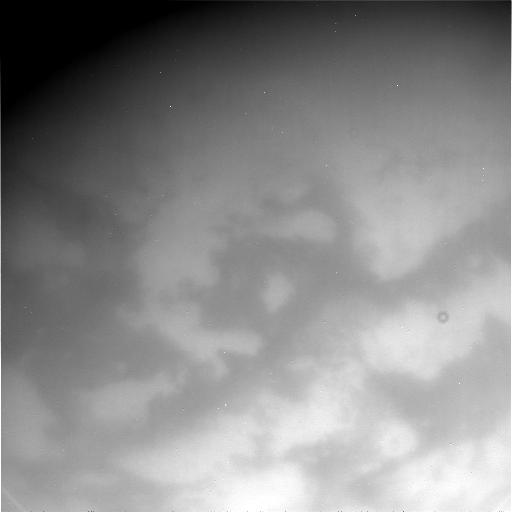
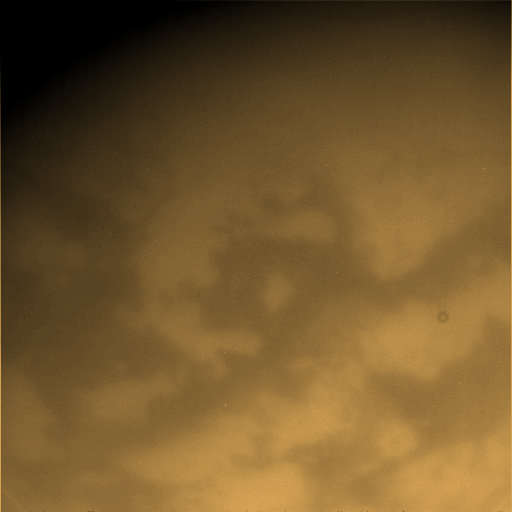
The image in the upper part of the table represents a raw view of a portion of Saturn's largest moon Titan obtained on April 3, 2016 with the eye of the Cassini orbiter. The view whose file name is N00258701.jpg was acquired on the basis of the CL1 filter and on the basis of the CB3 filter. The view had not been validated or calibrated at the time of the observation and a validated or calibrated version of the original image had to be archived with the Planetary Data System proposed by NASA. One can clearly discern the contrast between relatively bright and relatively dark surface features in this view. The image in the lower part of the table represents a colorized version of the original view. Credit for the original image: NASA/JPL-Caltech/Space Science Institute. Credit for the colorization process of the original image: Marc Lafferre, 2025. |
- To get further information on that news, go to: https://www.chalmers.se/en/current/news/k-unexpected-discovery-on-saturns-moon-challenges-our-view-on-chemistry-before-life-emerged/ and https://www.pnas.org/doi/10.1073/pnas.2507522122 .