December 18, 2025: A Reanalysis Of Radiometric Data Of Titan Obtained From The Cassini Probe Suggests A Slushy Interior Rather Than An Internal Ocean
A new study entitled « Titan's strong tidal dissipation precludes a subsurface ocean », published in the journal Nature on December 17, 2025 and proposed by a team of researchers involving Flavio Petricca and Julie Castillo-Rogez in particular reveals that the giant moon of the Gas Giant Saturn may contain a slushy interior rather than a subsurface ocean. The new conclusion is based on a reanalysis of radiometric data of Titan acquired from the Cassini orbiter during its long mission in the Saturn System. Planetologists had advanced, in 2008, that Titan contains a subsurface ocean of water beneath an external crust that is rich in hydrocarbons. That outcome was based on the analysis of radiometric data of that world during the close flybys performed by the Cassini spacecraft. Titan undergoes the gravitational influence of the Ringed Planet Saturn as well as the gravitational influence of the other moons of the Gas Giant such as Tethys, Dione, Rhea or Iapetus. In its elliptical orbit around Saturn, the distance changes between Titan and Saturn imply changes in the gravitational influence of the Gas Giant. Changes in the gravitational influence between the planetary bodies represent tidal phenomena.
Titan is in the list of those worlds of the Solar System that may contain a subsurface ocean dominated by liquid water. Moons like Europa, Ganymede, Enceladus, Tethys, Dione, Rhea or Triton are also thought to contain a subsurface ocean rich in liquid water. The planetologists have had the opportunity to mobilize the huge amount of data acquired from the Cassini spacecraft and from the Huygens probe in order to discover new features of the surface of Titan, to infer the internal structure of the giant moon or to create new theories or models of its chemistry or dynamics. The analysis of the radiometric data obtained during the 10 close approaches of Titan has revealed a relatively strong tidal flexing of the moon that is in line with the hypothesis of the presence of an internal ocean rich in liquid water. The new analysis of the radio signals proposed by the team of Flavio Petricca leads to a different conclusion. The researchers preclude the presence of an internal ocean beneath the external crust and suggest the presence of layers of slush and the potential presence of small pockets of warm water near the presumed rocky core of the Opaque Moon.
The study of the radio frequency communications traveling back and forth between the probe and the Deep Space Network proposed by NASA allows researchers to infer the potential internal structure of the world explored by the spacecraft. During any close flyby, the gravitational variations of the world whose distribution of mass is not perfectly uniform can have an impact on the behavior or on the speed of the probe so that planetologists can gather clues regarding the internal structure of the world. The speed of the spacecraft can slightly change, slightly increase or slightly decrease during the flyby due to gravitational factors related to the distribution of mass inside the world. The variations in speed of the probe modify the frequency of the radio waves sent from the spacecraft or received by the spacecraft. Those frequency changes of the radio waves represent the Doppler shift phenomenon. The study of the Doppler shift allows researchers to infer the gravity field of the planet or moon or to infer the shape of the planet or moon. The dynamics or the shape of the moon can change during its orbit around the planet due to distance variations closely related to gravity phenomena.
Due to tidal phenomena or tidal flexing, the shape of Titan slightly changes due to the variations in the gravitational field of Saturn that squeezes the Orange Moon when that world evolves closer to the Gas Giant and that stretches Titan when the moon evolves farther from Saturn in its elliptical orbit. Tidal forces imply the production of energy that is lost or dissipated in the form of internal heating. Planetologists had analyzed the radio frequency data in order to evaluate the internal heating of the moon and they had been in a position to advance that there must be an internal layer likely rich in liquid water beneath the external crust likely rich in water ice and hydrocarbons. Their assumption was based on the fact that a relatively strong tidal flexing was deduced or observed. A solid interior would have implied a weaker tidal flexing due to a weaker distortion potential. An orange can be more distorted than a pétanque ball due to its soft interior. That's the analogy that one can have in mind to understand the level of tidal flexing of the moon depending on its internal structure. Let's keep in mind that the mean density of Titan is much lower than the mean density of the Earth so that the potential distortions can potentially be stronger on Titan.
The planetologists of the new study have envisaged another configuration that could account for the relatively strong tidal flexing of the giant moon. The interior could contain layers composed of a mix of ice and water that can engender the observed flexibility of the moon. That configuration implies a lag of several hours between the tidal pull of the Gas Giant and the moment when the moon undergoes the tidal forces. The tidal flexing process is supposed to be much slower if the interior is fully liquid. In the configuration of a slushy interior, there would be a stronger energy dissipation signature of the material in the gravity field of the world compared to the configuration of a liquid layer. The stronger energy dissipation phenomenon would be explained by the fact that the layers of slush would produce frictions and heat when the ice crystals rub against one another. The team of planetologists led by Flavio Petricca resorted to a new processing technique in order to correctly analyze the Doppler data. The researchers were in a position to reduce the noise in the data and they could identify the signature of a strong energy loss deep inside the Opaque Moon.
The planetologists determined that this signature came from layers of slush hidden beneath a thick crust of solid ice. Therefore, they don't envisage a subsurface ocean beneath the external crust. Their outcome is different from the outcome of the prevailing models that predict a subsurface ocean dominated by liquid water. They envisage, however, pockets of meltwater beneath the external crust. The pockets of meltwater or liquid water can be present thanks to the heat related to dissipating tidal energy. They may tend to slowly migrate toward the frozen layers of ice at the level of the surface. The various interactions of those presumed pockets of meltwater or liquid water are likely to enrich their chemistry. Meltwater or liquid water is likely to interact with hydrocarbons such as methane, ethane, propane, acetylene or benzene or to interact with organics or even prebiotic molecules such as nucleobases or sugars. We know that the global haze of Titan can engender relatively complex molecules that can fall to the surface. The liquid water of the presumed pockets could boost chemical interactions mobilizing key elements such as carbon, hydrogen, nitrogen or oxygen and key molecules such as methane, ethane, sugars or even amino acids.
Titan clearly represents a natural laboratory regarding the chemistry of hydrocarbons and regarding the chemistry of organics. What type of hydrocarbons or organics can nature produce or engender in the absence of life ? We know, now, that meteorites or comets can contain prebiotic molecules such as amino acids or sugars. Those comets or meteorites can collide with the surface of Titan from time to time. The energy of the impact can also boost chemical reactions in a harsh environment where all the ingredients or almost all the ingredients of the life we know are present. Over a long period of time, convection phenomena between the surface and the interior can be observed, a configuration that favors chemical reactions between various types of molecules or elements. The team of Flavio Petricca was in a position to deduce the potential presence of those pockets of liquid water or meltwater thanks to their new technique that reduces the noise in the Doppler data. The researchers envisage a slush that is sufficiently soft or flexible to make the moon bulge or compress under the influence of the tides of the Gas Giant Saturn. A sufficient amount of heat is removed to prevent the formation of a subsurface ocean.
The team of Flavio Petricca doesn't rule out the hypothesis of a prebiotic chemistry or even the hypothesis of a biosphere containing relatively simple life forms. At the level of the surface, water can only appear in its solid form so that any biological chemistry involving liquid water can't be envisaged. However, beneath the external crust or the icy crust, the environment can become warm enough to allow the presence of stable liquid water so that any typical life form based on liquid water and carbon could be envisaged. Could the presumed pockets of meltwater or liquid water host basic life forms such as archaea or bacteria ? That's a captivating question that can also apply to the numerous icy worlds of the Outer Solar System that are thought to contain a subsurface ocean rich in liquid water. The researchers of the study envisage that the presumed liquid water of the presumed pockets could be as warm as 20 degrees Celsius (68 degrees Fahrenheit). That liquid water could contain nutrients emanating from the rocky core and from slushy layers of high-pressure ice. There must be an interesting chemical cycle between the interior, the external crust and the atmosphere. The rotorcraft of the Dragonfly mission will likely tell us much more about the environment and the interior of the giant moon of Saturn.
|
|
|
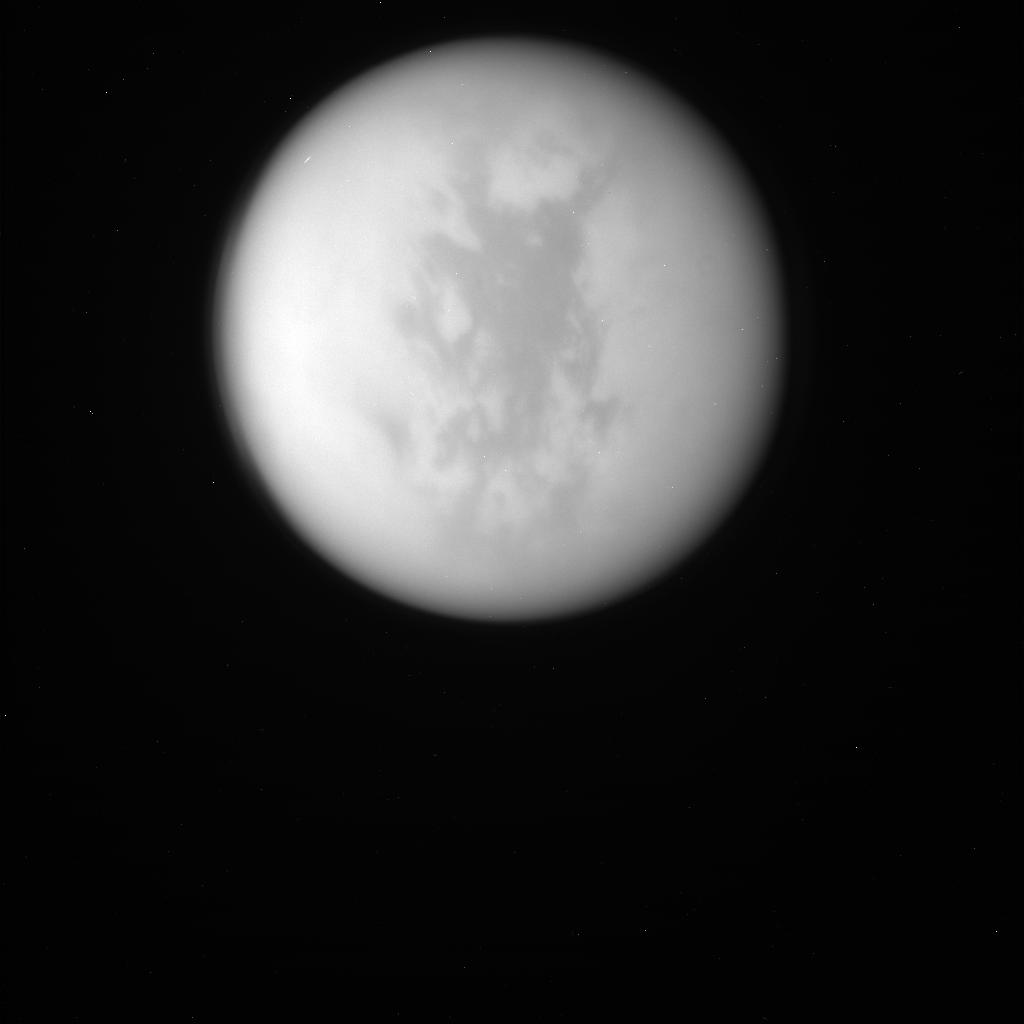
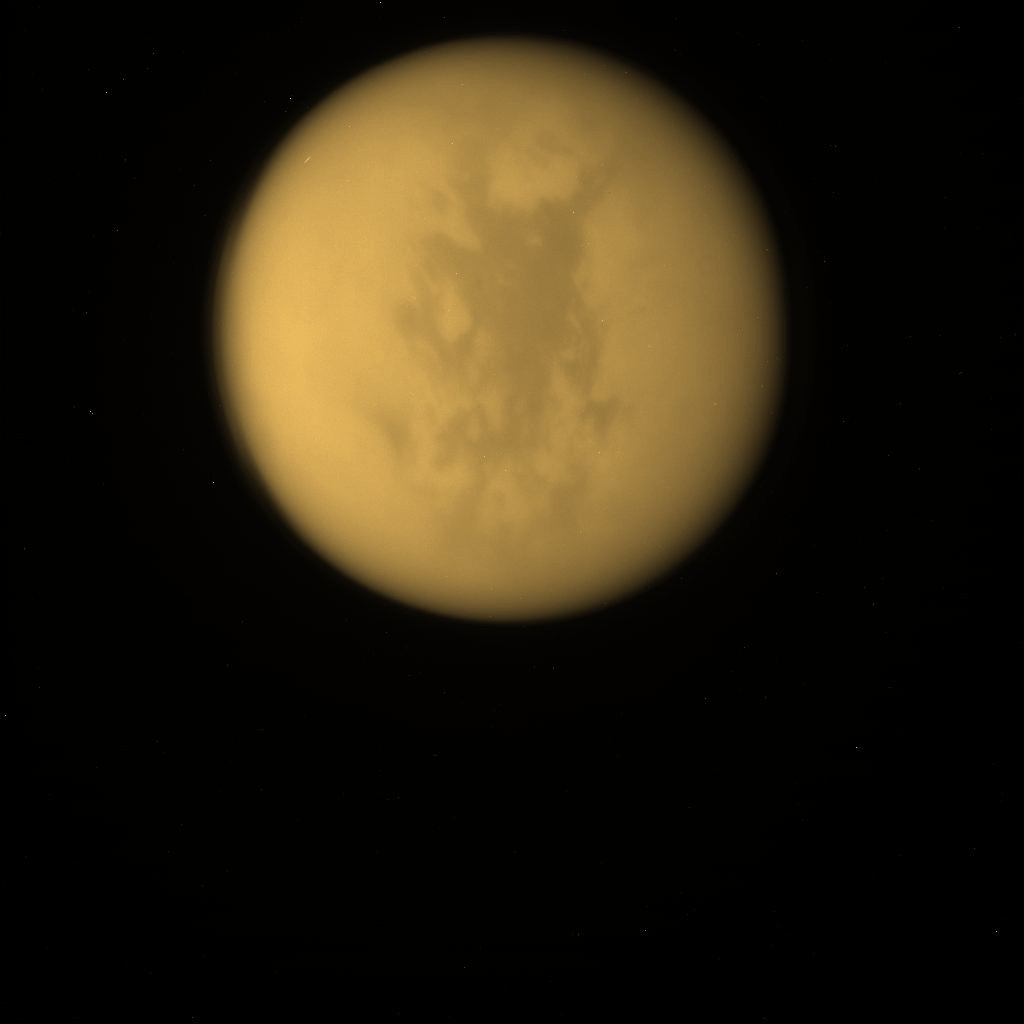
The image in the upper part of the table represents a raw view of Titan obtained from the Cassini spacecraft on December 16, 2011. The view whose file name is N00179083.jpg was captured on the basis of the CL1 filter and on the basis of the CB3 filter. The image had not been validated or calibrated at the time of the observation and a validated or calibrated version of the original view had to be archived with the Planetary Data System proposed by NASA. The disk of Saturn's largest moon clearly reveals the well-known contrast between relatively dark areas and relatively bright areas on the surface. The image in the lower part of the table represents a colorized version of the original view. Credit for the original image: NASA/JPL-Caltech/Space Science Institute. Credit for the colorization process of the original image: Marc Lafferre, 2025. |
- To get further information on that news, go to: https://www.nasa.gov/solar-system/planets/saturn/saturn-moons/titan/nasa-study-suggests-saturns-moon-titan-may-not-have-global-ocean/ and https://www.nature.com/articles/s41586-025-09818-x.